Insider Compass
An expert assessment built on data, context and gastronomic judgement.
About Shirube Shimokitazawa
Shirube Shimokitazawa brings the izakaya tradition into contemporary territory with dishes that honor Japanese foundations while pushing playful boundaries. This Shimokitazawa institution has earned its following through signature preparations like blowtorched mackerel, slow-braised beef tendon stew, and an oden program that draws regulars year-round. The kitchen's willingness to cross-pollinate—pairing Japanese beef stew with crusty garlic bread, for instance—reflects the neighborhood's creative, bohemian spirit without sacrificing technical integrity.
Good to know
Arrive right at opening (5pm) to secure a spot without reservation, especially if you're a party of four or more—the place fills fast and stays packed through the night.
The Insider Compass
Four dimensions, each assessed independently against the same criteria everywhere we rate.
Plate
The cooking here balances izakaya classics with inventive riffs that feel natural rather than forced. Aburi saba (blowtorched mackerel) gets the tableside treatment, its skin crisping and blistering while the flesh stays buttery, and the beef tendon stew achieves that deep, collagen-rich unctuousness that only comes from patient, low-temperature cooking. The oden selection demonstrates proper dashi work, while dishes like tuna-avocado dip with bread show the kitchen's comfort moving between traditions.
Vibe
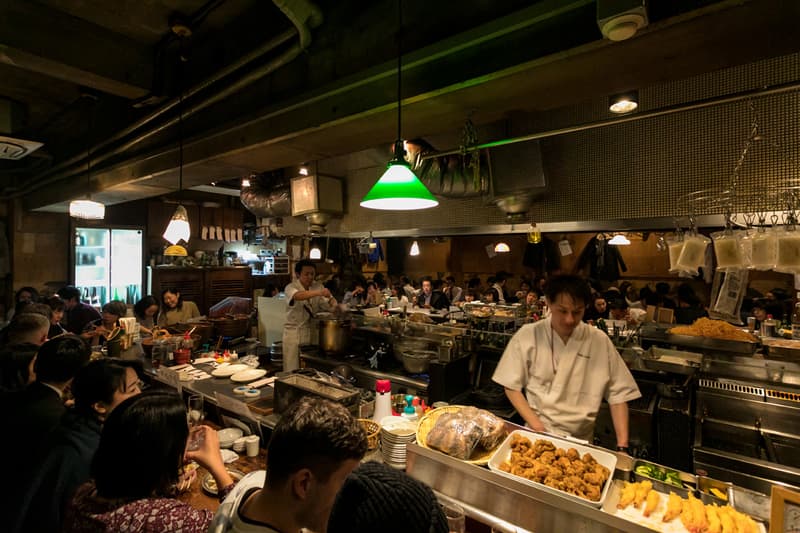
BuzzingThis is high-energy izakaya theater—flames flaring, orders shouted across the pass, sake flowing from bamboo cylinders meant for sharing. The concrete-meets-traditional aesthetic fits the Shimokitazawa vibe perfectly, with a mix of sunken tatami seating and conventional tables accommodating a young, international crowd alongside neighborhood regulars. Expect noise, movement, and the kind of controlled chaos that signals a kitchen firing on all cylinders.
Service
The brigade moves with impressive choreography despite the frenetic pace, managing a packed dining room with efficiency and genuine warmth. English menus are readily available, and staff navigate the language barrier with good humor and helpfulness. Even during peak service, the team maintains momentum without sacrificing hospitality—a testament to solid training and veteran coordination.
Setting
The space cleverly masks its size behind a modest entrance, opening into a sprawling room that seats over eighty across multiple stations including traditional sunken floor seating. Industrial concrete blends with Japanese design elements, creating an atmosphere that feels both urban and rooted in tradition. The open kitchen becomes a stage, with chefs torching fish and brûléeing desserts in full view—part cooking, part performance.
These four dimensions are a handful of the attributes we review. The Insider Rating also draws on research the compass does not display — among them the wine programme, the size and quality of the cellar, the location, and how long the house has operated. It is not an average of the scores above.
Go for
- High-energy izakaya experience with creative twists on traditional dishes
- Tableside theater with blowtorched preparations and lively atmosphere
- Shimokitazawa's bohemian neighborhood vibe paired with serious cooking
Don't go for
- Quiet, intimate conversation—the energy level runs consistently high
- Traditional-only izakaya purists unwilling to embrace fusion elements
Details
2-chōme-18-2 Kitazawa, Setagaya City, Tokyo 155-0031, Japan
$$